مرحبا بك في
Greensun Solar Energy, please call
+86 187 1510 8506
for help
 العربية
 English
 français
 español

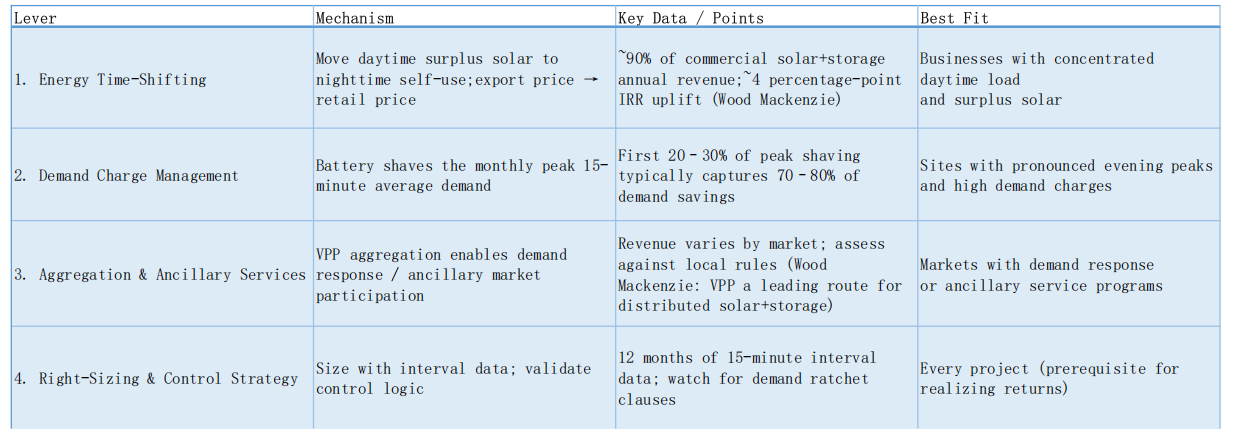
Core idea: Storage re-prices the same kilowatt-hour across time—shifting it from low-value midday hours to high-value evening peaks, and from cheap export rates to retail self-consumption rates.
1. Energy Time-Shifting
Storage moves daytime surplus to nighttime self-use, converting each kWh from export price to retail price—a spread that can be several times larger.
2. Demand Charge Management
Solar cuts kWh but not necessarily kW; the battery shaves the monthly peak 15-minute demand that solar alone can't touch. Shave the first 20–30% to capture most savings—deeper shaving inflates capacity disproportionately.
3. Aggregation & Ancillary Services
VPP-aggregated batteries can earn demand response or ancillary market compensation on top of arbitrage—revenue varies by market and must be assessed against local rules.
4. Right-Sizing & Control Strategy
Size with 12 months of 15-minute interval data, not monthly bills, and validate control logic against demand ratchet clauses during commissioning.
Conclusion: Lever priority depends on the load profile—Lever 4 is the prerequisite for realizing any of them. Without stacking, storage is just an expensive battery; with stacking, it's the lever that pushes solar ROI higher.



 شبكة IPv6 مدعومة